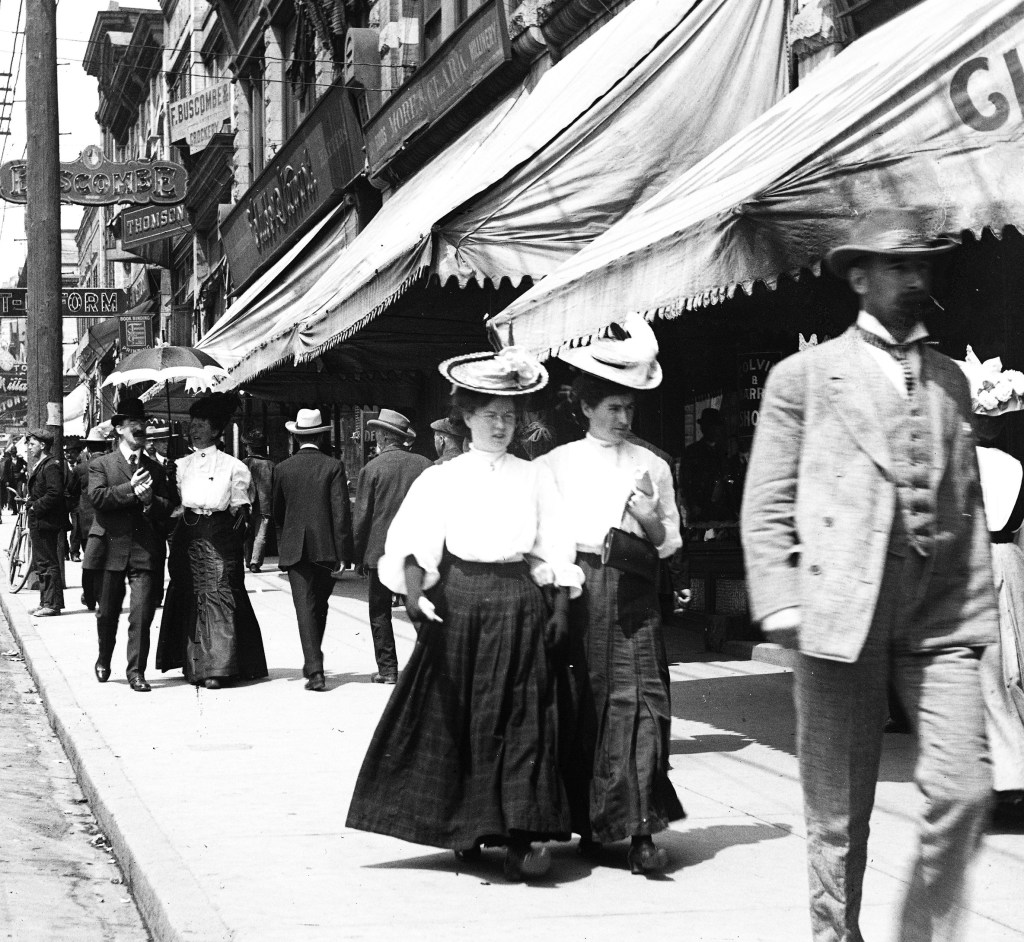
Phillip Timms photo #6678
Vancouver Public Library
When 18-year old Annie Shepard boarded a ship in Liverpool in 1885 she didn’t care where she was headed as long as it meant she got away from the factory where she’d worked since she was a girl.
And if the sponsors who financed her passage to the wilds of Canada expected her to marry, have children, and stop the colony’s slide into depravity, she considered it a fair trade.
Still, the idea that she would have a civilizing influence on Vancouver strikes Annie as comical because she, herself, is no innocent. But if she can curb her factory-girl predilections, she can break away from her old life, even here, a place that is little more than a sawmill and a few shacks and saloons strung along the waterfront.
But when a remarkable change occurs in Vancouver’s fortunes a year later the tiny settlement is transformed into a metropolis teeming with ambitious land speculators there to cash in on the development.
Annie cares less about that than about the hundreds of young men who wear suits instead of overalls arriving in the city. Unlike men at the Hastings Sawmill, these newcomers offer her the the chance of a life better than she’d ever imagined.
In the year of 1886, amid the disruption of a riotous mob storming Hastings Sawmill, a hotly contested municipal election, and a fire that destroys the young city, Annie and her beau get married just in time to avoid a scandal.
But all is not well and after only a few years, Robbie’s obsession with climbing the social ladder at the expense of his family reaches a breaking point and Annie’s loyalty begins to waver.
A decade later, the feminist movement, and her own sister’s role in the telephone operators’ strike tests Annie’s loyalties and forces her to make a decision she’d been resisting for years.
Interweaving authentic history and characters along with fictionalized ones, and with a background of land speculation, confiscation of Squamish territory, and women’s suffrage Factory Girl tells of a little known era in Vancouver’s history and the changing place of women in Edwardian society.
Factory Girl is a work in progress.
If you’d like to follow me as I research, fine-tune, and continue to edit this story, please sign up to follow me on the journey.
In exchange, I’d like to offer you my reading of a short story I wrote about a young man who attempted a daring escape from Communist China in the early 1960s. It’s called Crossing Over
 DJ MacKinnon Writing